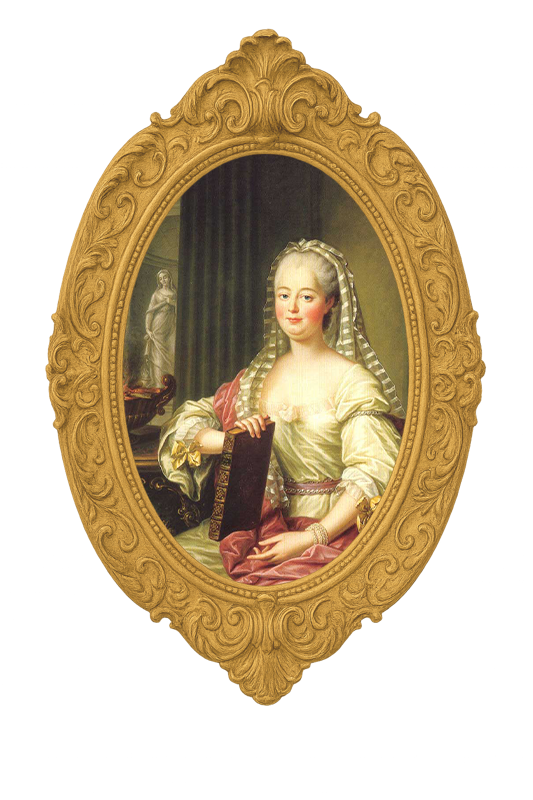
Madame de Pompadour, née Jeanne-Antoinette Poisson
Born in 1721, Jeanne-Antoinette was first married to Charles-Guillaume Le Normant d’Étiolles. She had two children from this union: Charles-Guillaume-Louis, born in December 1741 and Alexandrine, born in August 1744. Both died at a young age. Jeanne-Antoinette was ennobled as Marquise de Pompadour when she became king Louis XV’s official mistress, in 1745. The relationship lasted nearly twenty years. She died in 1764 from a pulmonary ailment, most likely tuberculosis. She was forty-two.
That Madame de Pompadour is represented as a Vestal Virgin is quite allegorical. An ancient roman priestesses’ role was to look after the holy fire. Jeanne-Antoinette was Louis XV’s actual lover for only a few years. So, while celibate herself, she provided him with young mistresses that, while stoking the flames of the king’s passion, did not pose a threat to her position.
In the painting
Worth noting: the beautiful white pearls she is wearing are symbols of luxury and virtue, ideals dear to the marquise. Jeanne-Antoinette was an arbiter of style, an undisputed trendsetter when it came to fashion in all the courts of Europe.
In the novel
“When he opened the door to the vast room, lined with long shelves of items steeped in history, Jeanne-Antoinette was there, ready to greet Lou. He had placed her on an easel at eye level. She was undisturbed under her varnish, her skin radiant and her eyes bright despite her 242 years. Lou approached the painting, up close, like she wanted to have a private conversation. She refrained from touching her, but whispered, ‘Bonjour, Jeanne-Antoinette’.”
The painting fascinated Lou. Printed reproductions didn’t do it justice. The strikingly natural colours breathed life into the model. The artist’s flawless technique gave Jeanne-Antoinette the complexion of a young girl. Implausible, Lou noted to herself. The portrait was released by Drouais’s studio in 1762 or 1763. Madame de Pompadour died in 1764. She must have been a little the worse for wear! The painter had literally given her a makeover. That’s because they were good friends, those two. He would have wanted to show her in her best light, idealize her in some fashion. Photoshop before its time.”
Author’s note
I’ve had the chance to see Nattier’s Vestal Virgin up close, in the reserves of the now defunct Musée Stewart. This institution has since merged with the McCord Museum. The emotion of this improbable tête-à-tête with Madame de Pompadour remains one of my most vivid experience of all the research I’ve done about this remarkable woman.
Charles-Guillaume-Louis Le Normant D’Etiolles
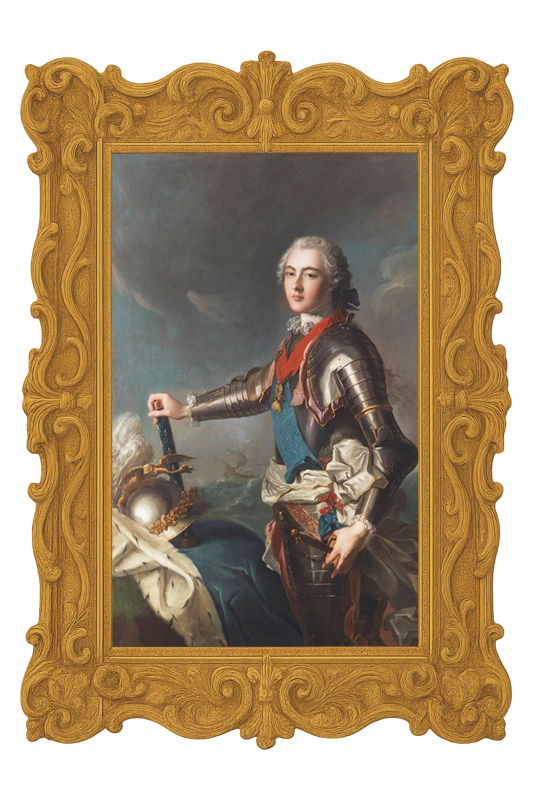
Charles-Guillaume-Louis Le Normant d’Étiolles, newly graduated from l’École Militaire de Paris is sent to Nouvelle-France (today’s Québec), under Louis-Antoine de Bougainville’s command. The facts about his birth and his death are known, but very little is known about his life. Truth be told, he seems to have disappeared from History, but for a cryptic mention of his name on an obscure document…
In the painting
Charles-Guillaume-Louis is a main character in my novel. The inspiration came from a painting of the young duc de Penthièvre, grandson of Louis XIV. Louis-Jean-Marie de Bourbon was born in 1725. This made him almost the same age as my hero, when he left for Nouvelle-France. The background showing ships on a troubled sea is evocative of the possible dangers that await him: a perilous Atlantic crossing, a new life under uncertain skies. The posture, the hair and subtle rouge are realistic. Charles-Guillaume would be wearing a blue military uniform, though. The pose reminds me of Marquis de Marigny’s portrait where he is showing plans. The fact that these two men seem to share a resemblance, like the one possible between an uncle and his nephew, was helpful in creating the marquise’s son.
In the novel
“I noticed Charles-Guillaume-Louis’s name on the passenger manifest of soldiers to be repatriated to France after the surrender of Montreal,” Alcide said. “With Quebec City conquered and Montreal taken, the French were to cede the entire colony to the British. Bougainville’s last order was to coordinate the return of French troops on English vessels. And Charles-Guillaume-Louis was on that document.”
Alcide, visibly moved, had to take a deep breath before continuing, whereas Lou stopped breathing. “However, he apparently never boarded any of those ships; his name was crossed out. And under the erasure, the highly legible words ‘Charles-Guillaume-Louis Le Normant d’Étiolles, dit Poisson’ with a note initialled L.A.B.—in all likelihood by Louis-Antoine de Bougainville himself—reading ‘Remained in New France’.”
Author’s note
The real Charles-Guillaume-Louis died in his first year. It is possible that he was sent to a wet nurse, never to return, a frequent occurrence among the nobles and the bourgeois in XVIIIth century France. I took the liberty of imagining that he had survived and was kept from public view by the marquise, maybe to protect her emotionally fragile royal lover from having to compete for her affections with a male child.
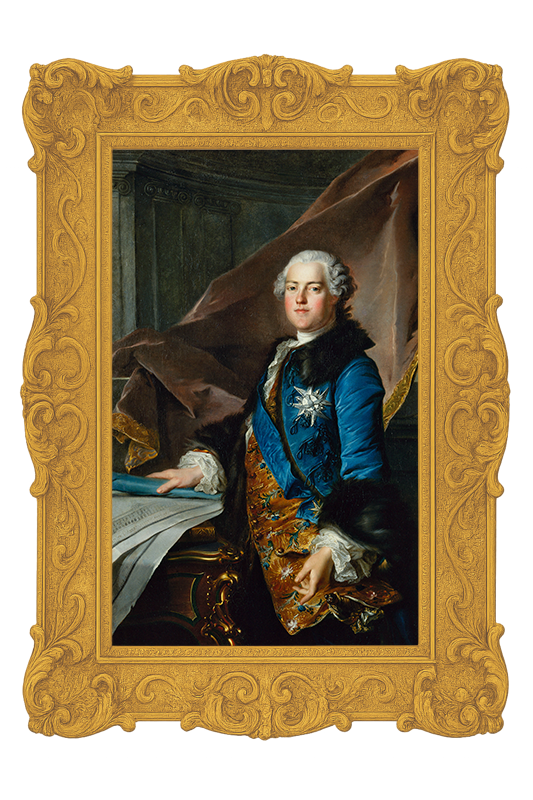
Abel-François Poisson de Vandières, Marquis de Marigny
Abel-François was Madame de Pompadour’s brother. Six years younger than his only sister, he would have an exceptional career as Directeur Général des Bâtiments du Roi creating the monuments for which the reign of Louis XV is best remembered: the church of Sainte-Geneviève (now the Panthéon), the Place Louis XV (now Place de la Concorde) and l’École Militaire de Paris (still a military site today). Like Jeanne-Antoinette, he was born a roturier or commoner, a fact he was never allowed to forget, in spite of his achievements.
In the painting
The model is holding in his right hand the plans of L’École Militaire. He wears the blue sash and silver plaque of l’ordre du Saint-Esprit. This portrait by Louis-Toqué (circa 1755) is on display at Musée Carnavalet in Paris.
In the novel
“Lou easily identified the handsome, slightly chubby man in the blue fur-trimmed suit. He was the marquis de Marigny, born Abel-François Poisson, Jeanne-Antoinette’s younger brother. Although he was around thirty when Louis Tocqué painted the portrait, his powdered wig and red cheeks made it impossible to tell his age. Beauty standards applying to both men and women at the court of Louis XV were egalitarian: years were erased by cosmetic artifice. Grey hair and rosy cheeks for all, young and old.
He also suffered because of the fishy name Poisson. In 1756, when he was appointed registrar of the ordre du Saint-Esprit, which entitled him to wear the cordon bleu, they teased that he was too small a fish to be dressed au bleu, a preparation method reserved for larger species.”
Author’s note
He would be the uncle of Charles-Guillaume-Louis, my fictional character.
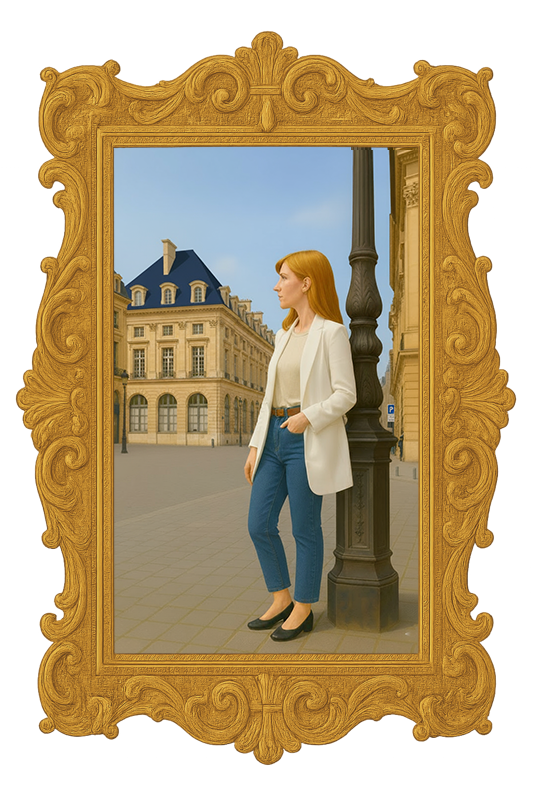
Lou Ashby
International career, no lack of friends or lovers, Québec-born Lou Ashby enjoys life in every way. However, under the successful façade, she is living a lie, hiding as she is behind an alias. When her real identity is unveiled, she embarks on a voyage in search of her true origins.
In the novel
“He liked everything he saw. She wore an updo to beat the mid-June heat. A loose bun showed off the graceful nape of her neck that he had only guessed at before. The pale skin of her face, of her shoulders bared by a boyish camisole, had not yet been browned by the summer sun. Her eyes, an indefinable colour, had turned green, like they were reflecting his. With her perfect posture, she could have been corseted.
Her Anglophone mother called her strawberry blonde; her Francophone father said she was blonde vénitienne. They were both right, in their own language.”
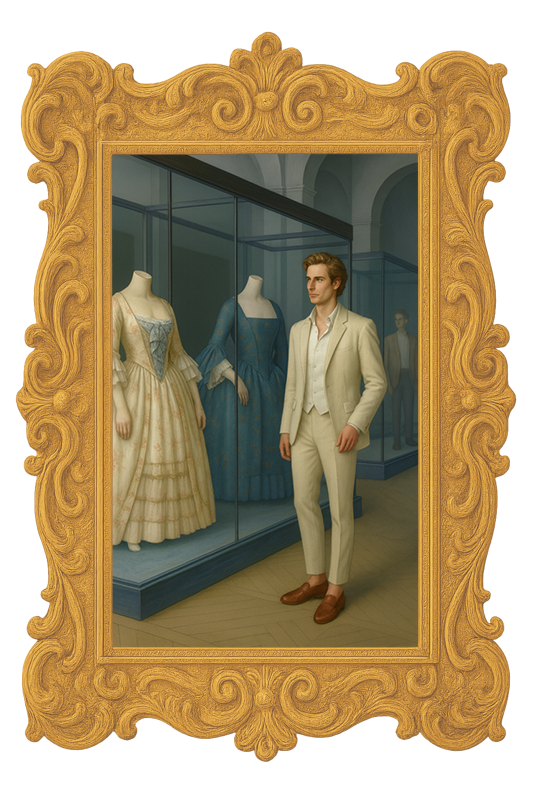
Geoffroy Le Hideux
Textile and costume historian Geoffroy Le Hideux is curator of garments collections at the Paris Musée des Arts Décoratifs. His noble ancestry, as heir to the ancient de La Roche-Forest dynasty, is a fact that he doesn’t like to make public. Like Lou, he is secretive about his true identity.
In the novel
“Turning to give her contradictory opinion, she found herself face-to-face with an impeccably dressed French dandy, who wore a Hermès-calibre heavy silk twill bowtie around the collar of his meticulous shirt. The handsome young man looked at her from his great height. He could have passed for an American basketball player but dressed to the nines as he was in his perfectly tailored double-breasted jacket, he looked more like a model on a catwalk.”
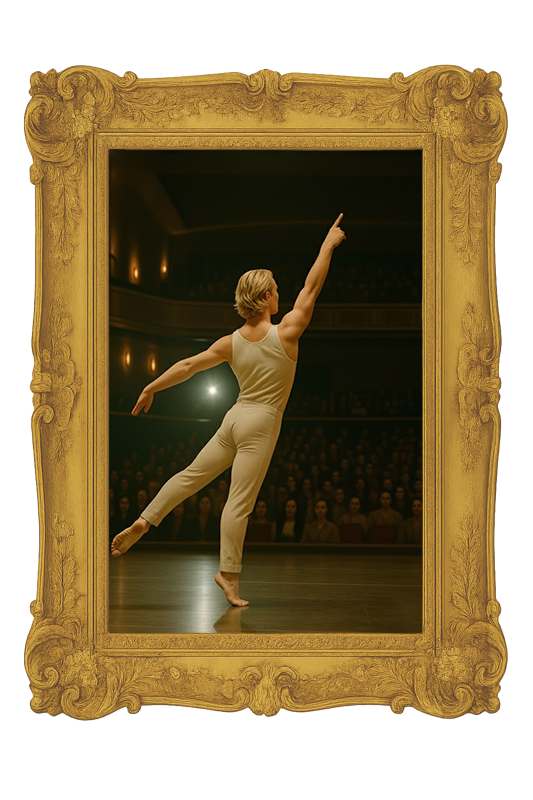
Corey Pointer
With his exceptional physique and stage presence, Corey Pointer has enjoyed an international career as a classically trained danseur étoile. Now in his mid-thirties, this Labrador-born artist is developing his talent as a contemporary choreographer.
In the novel
“Corey’s physique—a body befitting a men’s underwear ad with its toned, defined muscles— could drive any woman crazy with desire, especially when pulling her into an embrace inspired by those lavished by the sublime Prince Albrecht on his partner in the ballet Giselle. He was beautiful enough to fascinate both men and women. He had an aura of ambiguity around him, which amused Lou. His eyes, so light a brown as to seem almost gold, likely had something to do with it. They appeared to match the blond highlights in his hair. The abundance of sunshine he radiated led some to call him ‘the golden boy.’”